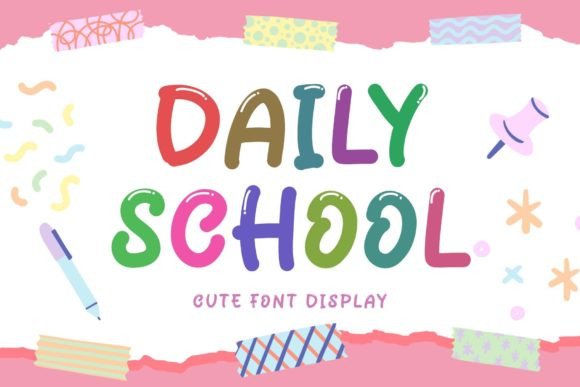
Bringing Playful Energy to Design with Daily School Font
In the vast landscape of digital typography, finding a typeface that strikes the perfect balance between professionalism and whimsy can be a challenge. Designers often struggle to find a font that feels approachable enough for children's content yet legible enough for serious communication. This is where Daily School steps in as a versatile solution. As a cute display font, it has quickly become a favorite among creative professionals looking to inject personality into their projects without sacrificing readability. Whether you are crafting a birthday invitation or designing an educational poster, this typeface offers a unique blend of charm and functionality.
The Aesthetic Appeal of a Cute Display Font
At its core, Daily School is designed to evoke feelings of nostalgia, warmth, and joy. The strokes mimic the natural imperfections of handwriting, creating a visual texture that feels human and authentic. Unlike rigid sans-serif fonts that can sometimes feel cold or corporate, the rounded edges and playful slant of this typeface immediately signal friendliness. This aesthetic is particularly powerful when the goal is to connect with younger audiences or to soften the tone of a message.
The "cute" factor isn't just about being decorative; it serves a psychological purpose. In design, rounded shapes are often perceived as safer and more inviting than sharp angles. When you apply Daily School to a project, you are subconsciously telling your audience that the content is accessible and fun. This makes it an ideal choice for brands that want to appear approachable, such as toy companies, childcare centers, or family-oriented blogs. The font acts as a visual bridge, making complex information feel less intimidating and more engaging.
Comprehensive Character Sets for Global Projects
One of the most impressive aspects of Daily School is its robust character set. Many display fonts fall short by offering only basic Latin characters, limiting their use to English-only projects. However, this font goes above and beyond by including uppercase letters, lowercase letters, numerals, and a wide array of punctuation marks. This completeness ensures that designers do not have to switch typefaces mid-project to include a special symbol or a number.
Beyond the basics, the inclusion of multilingual support opens up a world of possibilities. In our increasingly globalized digital environment, content creators often need to produce materials in multiple languages. With Daily School, you can maintain a consistent visual identity across different linguistic contexts. Whether you are designing a menu for a restaurant with international cuisine or creating educational materials for a diverse classroom, the font's ability to handle various character sets ensures inclusivity and consistency.
Ideal Applications: From Back to School to Holiday Greetings
The versatility of this typeface allows it to shine across a multitude of scenarios. Its name might suggest an academic focus, but its application extends far beyond the classroom. Let's explore how this font fits into various seasonal and thematic projects.
- Back to School Campaigns: As the new academic year approaches, schools and stationery brands need visuals that excite students. Daily School is perfectly suited for posters, welcome banners, and supply lists. It captures the anticipation of learning while remaining clear enough for parents to read important details.
- Kids' Birthday Parties: For invitations and party favors, the font adds a festive touch. Its playful nature complements colorful graphics and illustrations, setting the right mood for celebration. You can easily pair it with bright colors to create eye-catching designs that children love.
- Holiday Cards: During Christmas, Father's Day, or summer breaks, the font's friendly vibe works wonders. Imagine a Father's Day card with a heartfelt message written in this typeface; it feels personal and handwritten, adding an emotional layer to the greeting.
- Comics and Magazines: In the realm of publishing, clarity is key. Daily School works exceptionally well for dialogue bubbles in comics or headlines in children's magazines. It maintains high legibility even at smaller sizes, ensuring that the story flows smoothly.
Integrating into Modern Creative Workflows
Modern design workflows demand efficiency and flexibility. Tools like Adobe Illustrator, Photoshop, and Canva require fonts that render quickly and look good on both screens and print. Daily School meets these technical requirements seamlessly. Its file structure is optimized for web and desktop use, meaning there are no lag times when rendering text in complex layouts.
Furthermore, the font pairs beautifully with other typefaces. While it shines as a standalone display font, it also works well when combined with clean, geometric sans-serifs for body text. This contrast creates a dynamic hierarchy in your design, guiding the reader's eye from the playful headline to the informative content below. Designers appreciate this adaptability because it allows them to experiment with different styles without compromising the overall coherence of the project.
Practical Benefits for Educators and Content Creators
For teachers and educators, choosing the right font is not just an aesthetic decision; it is a pedagogical one. Children learning to read benefit from fonts that resemble handwriting they might encounter in their daily lives. Daily School mimics the style of early writing exercises, making it a practical tool for worksheets, flashcards, and classroom decorations. It helps bridge the gap between printed text and the messy reality of a child's first attempts at writing.
Content creators, on the other hand, value the font for its ability to increase engagement. In an era of short attention spans, a visually appealing headline can make the difference between a user clicking away or staying to read more. By using Daily School for blog titles, social media graphics, or video overlays, creators can instantly grab attention. The font's distinctiveness helps brands stand out in crowded feeds, fostering a sense of familiarity and trust with the audience.
Considerations Before Adopting the Font
While Daily School is incredibly versatile, it is important to consider the context before adopting it for every project. Like any display font, it is best used sparingly. Overusing it in large blocks of text can lead to visual fatigue and reduced readability. It thrives as a headline font, a logo element, or for short phrases rather than long paragraphs.
Additionally, designers should think about color contrast. Because the font has a casual, hand-drawn feel, pairing it with low-contrast backgrounds can make it difficult to read. To maximize its impact, ensure there is sufficient contrast between the text and the background. Bold colors work well, but so do soft pastels if the stroke weight is adjusted appropriately. Understanding these nuances will help you leverage the full potential of the typeface.
Why Daily School Stands Out in Typography Trends
Current design trends are moving away from sterile perfection toward authenticity and imperfection. Handwritten and brush-style fonts are dominating the market because they feel more human. Daily School aligns perfectly with this shift. It offers the reliability of a structured font while retaining the organic charm of a sketch. This duality makes it a timeless choice that won't look dated in a few years.
Moreover, the font's multilingual capabilities position it as a forward-thinking asset. As businesses expand globally, the need for inclusive design grows. Having a font that supports various languages without losing its character is a significant advantage. It simplifies the localization process, allowing teams to maintain brand consistency across borders.
Ultimately, Daily School is more than just a collection of letters; it is a tool for storytelling. Whether you are celebrating a child's birthday, welcoming students back to class, or launching a new product for families, this font brings a smile to the face of your audience. Its combination of cuteness, functionality, and broad support makes it an essential addition to any designer's toolkit. By understanding its strengths and limitations, you can create projects that are not only beautiful but also deeply resonant with your intended viewers.