Westona: A Practical Evaluation of a Modern Classic Western Typeface
The resurgence of vintage aesthetics in modern graphic design has created a renewed demand for typefaces that authentically capture the spirit of the American frontier. Among the latest additions to this category is Westona, a display font designed by Howdy Let us. While the market is saturated with "western" fonts ranging from playful cartoon styles to overly distressed grunge textures, Westona positions itself as a refined alternative that balances historical accuracy with contemporary usability. For designers, marketers, and creative directors aged 20 to 50 who are tasked with evoking nostalgia without sacrificing legibility, understanding where Westona fits within the broader typographic landscape is essential.
This article provides an objective analysis of Westona, examining its structural characteristics, comparing it to traditional western alternatives, and outlining specific scenarios where it offers distinct advantages or potential limitations. The goal is to help you determine if this typeface aligns with your project requirements or if a different approach might serve your design better.
Defining the Character of Westona
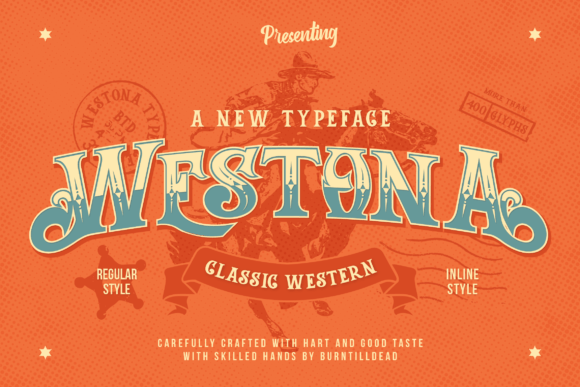
At its core, Westona is a display typeface engineered to replicate the visual language of late 19th-century saloon signage and wanted posters. Unlike generic western fonts that often rely on exaggerated serifs or inconsistent stroke widths to simulate age, Westona employs a more disciplined geometric structure. It captures the bold, adventurous spirit of the cowboy era through precise detailing rather than chaotic distressing.
The font's primary distinction lies in its inline style and extensive character set. The inline feature adds a secondary stroke within the main letterform, creating a sense of depth and dimensionality reminiscent of hand-painted wood signs. This detail elevates the typeface above flat, single-stroke alternatives, giving it a premium feel suitable for high-end branding. Additionally, the inclusion of special characters allows for greater flexibility in logo design, enabling creators to incorporate unique flourishes that standard fonts lack.
From a technical standpoint, Westona is optimized for large-scale applications. As a display font, it is intended for headlines, logos, and short phrases rather than body copy. The stroke weight is substantial, ensuring visibility even when scaled down moderately, though readability diminishes significantly at small sizes. This characteristic makes it a tool for emphasis rather than narrative text.
Comparative Analysis: Westona vs. Traditional Western Styles
When evaluating Westona against other options in the western genre, several key differences emerge regarding aesthetic intent and functional application. The western typography category generally divides into three sub-styles: the "Wanted Poster" look, the "Saloon Sign" look, and the "Modern Minimalist" interpretation.
Traditional "Wanted Poster" fonts often feature heavy distortion, uneven baselines, and simulated ink bleed to convey urgency and roughness. While effective for specific thematic needs, these fonts can appear dated or cluttered in modern commercial contexts. In contrast, Westona maintains a cleaner baseline and consistent spacing, offering a more polished interpretation of the same era. It retains the rugged charm but removes the excessive noise that can detract from brand clarity.
Compared to "Saloon Sign" fonts, which frequently utilize ornate swirls and decorative ligatures, Westona strikes a middle ground. It incorporates the necessary ornamentation through its inline details and special characters but avoids overwhelming the viewer with excessive decoration. This balance makes it more versatile for digital media, where screen resolution and varying device sizes require sharper, less intricate forms.
Finally, when compared to "Modern Minimalist" western fonts—those that strip away all period-specific details in favor of simple slab serifs—Westona offers significantly more atmospheric depth. Minimalist options may be safer for corporate branding, but they often fail to evoke the specific emotional resonance of the Old West. Westona succeeds where minimalist fonts fall short by providing immediate contextual cues through its inline styling and serif structures.
Key Differentiators
- Legibility: Westona prioritizes clear character recognition over stylistic exaggeration, making it more readable than heavily distressed alternatives.
- Detail Level: The inline style adds texture without compromising the overall shape of the letters, distinguishing it from flat vector fonts.
- Versatility: The expanded character set supports complex logo designs that simpler western fonts cannot accommodate.
Strengths and Tradeoffs in Design Application
Every typeface comes with inherent tradeoffs, and Westona is no exception. Understanding these factors is crucial for making an informed decision about its inclusion in a design system.
Strengths: The most significant advantage of Westona is its ability to instantly establish a mood. The combination of bold strokes and vintage detailing creates an immediate association with the frontier, adventure, and heritage. This makes it highly effective for industries such as hospitality (breweries, distilleries), fashion (rugged outdoor wear), and entertainment (film posters, event marketing). The inline style also adds a layer of sophistication, allowing the font to work in upscale contexts where cheaper-looking western fonts would feel out of place.
Tradeoffs: The primary limitation of Westona is its classification as a display font. It is not designed for paragraphs of text. Attempting to use it for body copy will result in poor readability due to the intricate details and tight kerning required for the inline effects. Furthermore, while the font works exceptionally well in black and white or high-contrast color schemes, its effectiveness can vary in low-contrast environments. The inline details may disappear if the background color is too similar to the text color, requiring careful color selection during implementation.
Another consideration is file size and rendering performance. Fonts with complex inline details and numerous special characters can have larger file weights, which may impact loading times on web projects if not optimized correctly. Designers must ensure that the font files are properly compressed and served via efficient protocols like WOFF2 to maintain site performance.
Decision Factors: When to Choose Westona
Selecting the right typeface depends heavily on the specific goals of the project. Westona is the ideal choice when the objective is to communicate authenticity, history, and boldness without appearing kitschy. It excels in scenarios where the design needs to bridge the gap between historical reference and modern professionalism.
Best-Fit Situations:
- Brand Identity: For companies seeking a logo that stands out in a crowded market, Westona offers a distinctive silhouette that is memorable yet professional.
- Event Marketing: Posters, flyers, and digital banners for festivals, rodeos, or themed parties benefit from the font's energetic and nostalgic appeal.
- Packaging Design: Product labels for craft beverages, tobacco, or leather goods can leverage the font's vintage charm to suggest quality and tradition.
When to Consider Alternatives: Conversely, there are situations where Westona may not be the best fit. If the project requires extensive body text, a serif or sans-serif font with higher x-height and open counters should be selected instead. Additionally, if the target audience is strictly corporate or tech-focused, the overt western styling of Westona might clash with the desired tone of innovation and minimalism. In cases where a subtle nod to the west is needed rather than a full immersion, a plainer slab serif might be a more appropriate alternative.
Practical Implementation and Styling Tips
To maximize the impact of Westona, designers should consider how it interacts with other elements in the layout. Because the font is inherently bold, pairing it with a neutral, clean sans-serif for supporting text creates a strong visual hierarchy. This contrast ensures that the headline commands attention while the body text remains accessible.
Color plays a vital role in highlighting the inline details. Using metallic finishes, deep earth tones, or high-contrast combinations like black and gold can enhance the vintage feel. However, designers should avoid overly saturated neon colors, which can undermine the historical authenticity the font aims to convey. Testing the font at various sizes is also critical; what looks impressive on a billboard may lose its definition on a mobile screen. Always preview the final output across different devices before finalizing the design.
Ultimately, Westona represents a thoughtful evolution in western typography. It respects the traditions of the past while addressing the functional needs of modern design. By weighing its strengths against its limitations and comparing it to available alternatives, designers can make a confident decision on whether this typeface serves their specific creative vision. Whether used for a bold logo or a striking poster, Westona offers a reliable tool for bringing the enduring allure of the Wild West into contemporary visual communication.