Evaluating Malacca: A Practical Guide to This Vintage-Inspired Typeface
In the crowded landscape of digital typography, finding a font that balances historical authenticity with modern legibility is often a challenge. Malacca (also stylized as Melacca) enters this space as a distinct option for designers seeking to evoke nostalgia without sacrificing clarity. Drawing inspiration from vintage signage and ephemera books, this typeface offers a unique blend of retro charm and contemporary utility. For professionals aged 20 to 50 who are tasked with branding, packaging, or editorial design, understanding where Malacca fits within your toolkit requires a look beyond its aesthetic appeal. This evaluation explores the specific characteristics of Malacca, compares it to broader typographic categories, and outlines the scenarios where it serves best.
The Distinctive Character of Malacca
At its core, Malacca is defined by its ability to capture the essence of classic typography while introducing subtle modern refinements. Unlike many fonts that rely on heavy distressing or artificial aging effects to simulate an antique look, Malacca achieves its vintage feel through letterform structure and weight distribution. The design mimics the wear and tear found on old wooden signs and printed book covers, yet it retains clean edges that ensure readability at various sizes.
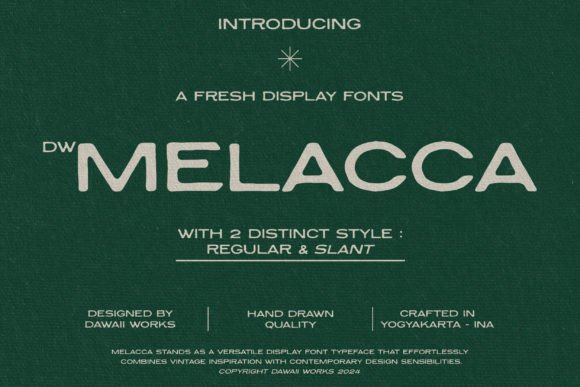
The typeface is available in two primary styles: Regular and Slant. This limited but focused offering allows for versatility without overwhelming the user with excessive variations. The Regular style provides a sturdy, upright presence suitable for headlines and logos, while the Slant variant introduces a sense of motion and informality, ideal for subheadings or accent text. The distinctive letterforms feature slightly irregular curves and varying stroke widths, which prevent the text from appearing too mechanical or sterile. These nuances are what separate Malacca from standard slab serifs or generic display fonts.
Comparing Malacca to Similar Typographic Categories
When evaluating Malacca, it is helpful to compare it against other popular approaches to vintage-inspired design. The market is saturated with "retro" fonts, but they generally fall into a few distinct categories: distressed grunge, authentic period replicas, and stylized interpretations. Malacca occupies a middle ground between authentic replication and stylized interpretation.
- Distressed Grunge Fonts: Many vintage fonts rely heavily on texture overlays, speckles, and broken edges to create an aged look. While effective for specific artistic projects, these can often suffer from poor legibility at small sizes or when used in high-contrast environments. Malacca avoids this pitfall by keeping the texture inherent to the shape rather than applied superficially.
- Authentic Period Replicas: Some typefaces are direct digitizations of fonts from the 19th or early 20th century. While historically accurate, these can sometimes lack the optical adjustments needed for modern screen rendering. Malacca updates these classic forms with contemporary spacing and kerning, making it more functional for web and mobile applications.
- Modern Stylized Retro: Other fonts take a loose interpretation of vintage styles, often resulting in exaggerated features that can look cartoonish. Malacca maintains a more restrained approach, ensuring the design feels grounded and professional rather than gimmicky.
This positioning makes Malacca a strong contender for projects that require a "lived-in" feel without the maintenance issues associated with heavily textured fonts. It offers the visual interest of a hand-painted sign with the reliability of a modern type family.
Strengths and Tradeoffs in Design Application
Every typeface comes with inherent strengths and limitations. Understanding these tradeoffs is crucial for making an informed decision about whether Malacca is the right choice for a specific project.
Key Strengths
The primary advantage of Malacca is its versatility across different media. Because the letterforms are designed with clarity in mind, they translate well from large-scale posters to smaller packaging labels. The contrast between the bold strokes and the delicate details creates a dynamic visual rhythm that draws the eye. Furthermore, the inclusion of both Regular and Slant styles allows for hierarchical design without needing to switch typefaces, maintaining visual consistency throughout a brand identity.
Another significant strength is its emotional resonance. The font effectively communicates values such as authenticity, craftsmanship, and heritage. For brands looking to establish a connection with consumers who value tradition and quality, Malacca provides an immediate visual cue that aligns with those messaging goals.
Potential Limitations
However, the vintage aesthetic does come with constraints. Malacca is primarily a display font, meaning it is best suited for headlines, titles, and short blocks of text. Using it for long-form body copy could result in reader fatigue due to the decorative nature of the letterforms. Additionally, because the font relies on specific stylistic quirks, it may not pair well with other highly ornate or similarly styled typefaces. Careful pairing with a neutral sans-serif or a simple serif is usually necessary to balance the composition.
Designers should also consider the context of their audience. While the nostalgic appeal works well for lifestyle, food, beverage, and artisanal product sectors, it might feel out of place in industries that prioritize futuristic innovation or strict corporate minimalism.
Best-Fit Situations and Decision Factors
Determining when to choose Malacca involves analyzing the specific goals of your project. Here are practical scenarios where this typeface excels, alongside situations where alternative options might be preferable.
When Malacca Is the Right Choice
Malacca is an excellent fit for branding projects that aim to highlight heritage or artisanal quality. For example, a craft brewery, a boutique coffee roaster, or a vintage clothing retailer would benefit significantly from the font's warm, inviting character. In packaging design, where shelf presence is critical, the distinctive letterforms of Malacca can help a product stand out among competitors using more generic typography.
It is also well-suited for event posters, invitations, and editorial headers where a touch of personality is desired. The Slant style, in particular, adds a dynamic element that can guide the viewer's eye through a layout, making it useful for promotional materials that need to convey energy and movement.
When to Consider Alternatives
If your project requires extensive body text, such as a novel, a technical manual, or a news article, Malacca is likely not the optimal choice. In these cases, a dedicated text font with higher x-height and simpler forms will provide better readability. Similarly, if the brand identity relies on a stark, ultra-modern aesthetic, the organic curves of Malacca might clash with the overall visual language.
Furthermore, if the design requires a wide range of weights—from light to black—Malacca's current two-style offering may be limiting. In such instances, a more comprehensive type family might offer the flexibility needed to handle complex layouts.
Practical Examples of Effective Usage
To visualize how Malacca functions in real-world applications, consider a hypothetical rebranding for a local bakery. The goal is to emphasize traditional baking methods and homemade quality. Using Malacca for the logo and menu headers immediately establishes a connection to old-world bakeries, evoking images of flour-dusted counters and handwritten chalkboard signs. Pairing the Regular style for the main logo with the Slant style for daily specials creates a cohesive yet varied look.
Conversely, imagine a tech startup launching a new app. While they might want to appear "human" and approachable, using Malacca could inadvertently suggest a lack of technological sophistication. In this scenario, a cleaner geometric sans-serif would likely serve the brand's narrative better. This comparison highlights the importance of aligning typographic choices with the intended message and audience expectations.
Making an Informed Decision
Selecting the right typeface is a strategic decision that impacts how a brand is perceived. Malacca offers a compelling solution for those seeking to blend vintage aesthetics with modern functionality. Its ability to evoke authenticity and character makes it a valuable asset for specific creative projects, particularly in branding, packaging, and poster design.
However, like any tool, it has its limits. By weighing its strengths against potential tradeoffs and considering the specific requirements of your project, you can determine if Malacca is the right fit. Whether you are designing a label for a small-batch product or creating a poster for a cultural event, understanding the nuances of this font will help you make a choice that enhances your design rather than detracting from it. Ultimately, the best font is the one that serves your content and resonates with your audience, and for many, Malacca strikes that balance effectively.